Biography
000 — Loading
Home Biography Music Artistic Vision Gallery Contact

Tibetan Music Researcher · Royal Museum of Musical Instruments, Belgium

The Life & Journey

Biography

A lifetime dedicated to preserving and evolving Tibetan musical heritage — from the monastery schools of Labrang to the musicological institutions of Europe.

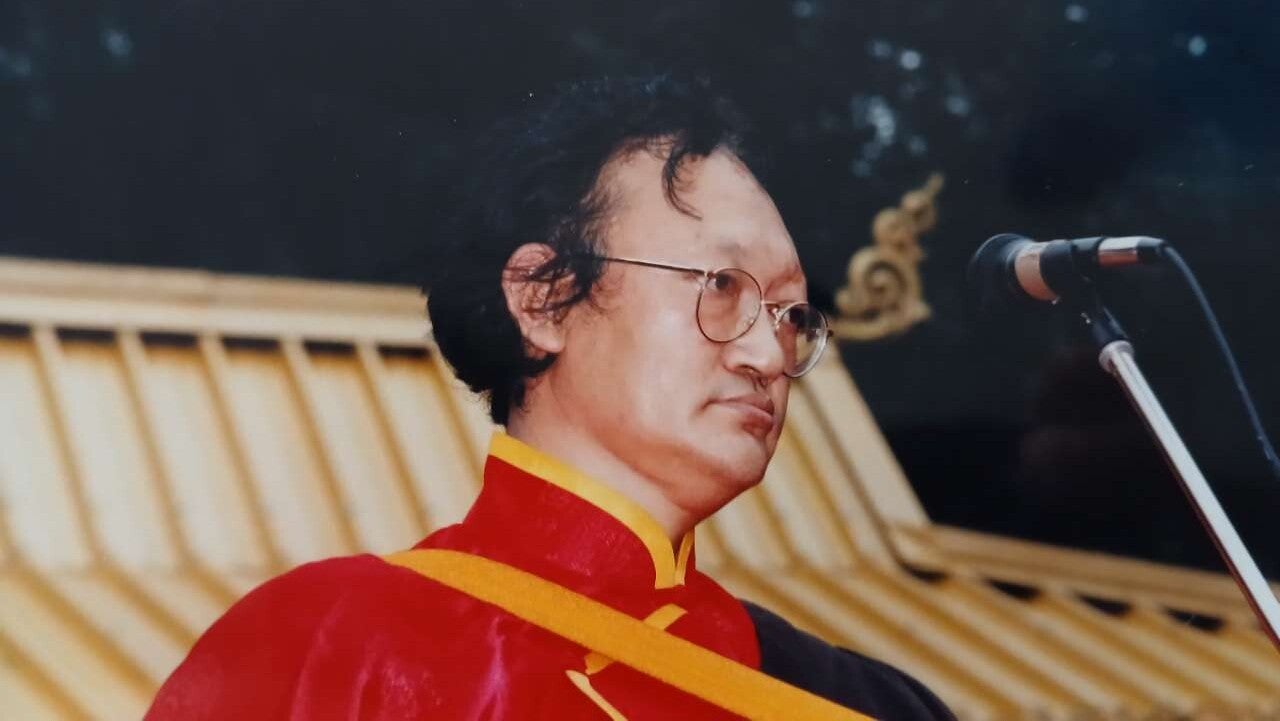
Portrait of Tsering Dondrup
Tsering DondrupComposer · Musicologist

Quick Facts

Born
Labrang Gannan, Gansu, China
Education
Labrang Tibetan Primary School · Gansu Provincial Sports School · School of Music, Minzu University of China (composition)
Primary Role
Composer · Musicologist · Researcher
Instruments
Cello · Violin · Double Bass
Current Position
Tibetan Music Researcher, Royal Museum of Musical Instruments, Belgium
01

Roots in Sacred Lands

Born in the highlands of Gansu Province's Tibetan regions, Tsering Dondrup's earliest memories were filled with the chants of monks from Labrang Monastery and the folk songs of herders echoing across vast grasslands. These sounds would become the foundation of his lifelong musical journey.

In 1966 he graduated from Labrang Tibetan Primary School, a pivotal institution for Tibetan cultural education. That same year he entered Gansu Provincial Sports School with dreams of athletic achievement. However, fate — and the tumultuous winds of the Cultural Revolution — had different plans.

“When one door closes, another opens. Sports gave way to music, and I discovered that my true athletic field was the grand stage of musical composition.”

As the Cultural Revolution swept through China his sports education was interrupted. Yet this disruption became a blessing in disguise. He redirected his passion toward music, immersing himself in Western music theory — harmony, counterpoint, musical form and traditional composition techniques. He studied violin (Hohmann books 1–4) and cello (Dowell books 1–5), and took up the double bass.

This rigorous foundation in both Eastern and Western traditions would prove invaluable, positioning Tsering as one of the few Tibetan musicians capable of bridging these two worlds with authenticity and sophistication.

02

The Professional Awakening 1975–1980

In 1975 Tsering's mastery of the cello earned him a position with the Gannan Tibetan Autonomous Prefecture Song and Dance Troupe. For five years he performed as a cellist, but the composer within him was already stirring.

The year 1980 marked a watershed moment — Tsering transitioned from performer to composer, and the Tibetan musical landscape would never be the same.

Historic Achievement: “A Xiang Lao Lao”

Tsering created “A Xiang Lao Lao” (阿香唠唠), a Tibetan-language song in the traditional “Lu” style with a revolutionary twist — it was the first Tibetan song ever accompanied by full Western orchestral arrangement.

This composition won the 1980 National Ethnic Performance Excellence Award and became beloved throughout the Amdo region. Its Han Chinese version, Beautiful Gannan Grasslands, continues to be performed by artistic troupes and singers to this day.

During this period he also composed music for the Zhouqu Tibetan dance Forest Love Song, becoming the first Tibetan composer to introduce Zhouqu Tibetan music to China's cultural mainstream.

03

Academic Refinement 1980–1982

Recognising the need for deeper theoretical knowledge, Tsering enrolled in the composition programme at the School of Music of the Minzu University of China from 1980 to 1982.

Under the mentorship of distinguished professors — Dai Hongwei, Tian Liantao, Xia Zhongtang, Yang Hongnian, Lü Shaoen and Zhao Yongshan — he refined his compositional voice, learning to articulate Tibetan musical sensibilities through sophisticated Western frameworks.

Upon graduation he immediately embarked on an ambitious project: composing 32 electronic keyboard pieces imbued with authentic Tibetan flavour. This made him the first Tibetan musician to perform traditional Tibetan-style music on electronic instruments.

“Technology should not replace tradition — it should amplify it, carry it further, make it accessible to new generations and new audiences.”

These electronic compositions became staple programming for radio exchanges between the Voice of the Straits, Tibet Tibetan Language Radio, Qinghai Tibetan Language Radio and Gannan Tibetan Language Radio — bringing Tibetan music into the modern broadcasting age.

04

Theatrical Triumph 1983–1987

Between 1983 and 1985 Tsering undertook his most ambitious project to date: the complete musical score for “Sai·Dun Yue and Dun Zhu”, an eight-act mythological dance drama.

While he collaborated with Dorje Tseden on one act, Tsering composed the vast majority of this large-scale theatrical work, making it the first such production fully scored by a Tibetan composer independently.

The drama's successful premiere garnered widespread attention. When it was performed in Beijing in 1987 it received critical acclaim and was awarded the Ministry of Culture's Outstanding Literary and Artistic Creation Award — a testament to both its artistic merit and cultural significance.

This achievement solidified his reputation not just as a composer of songs, but as a complete musical dramatist capable of sustaining emotional and narrative arcs across large-scale theatrical works.

05

Scholarly Contributions 1986–1990s

In 1986 Tsering participated in the National Tibetan Folk Song Integration Work Conference organised by the China Folk Song Integration Office in Lhasa — bringing together the leading scholars and practitioners dedicated to documenting Tibetan musical heritage.

Throughout the late 1980s and 1990s he became a pioneering figure in Tibetan music technology and documentation:

Digital Pioneer
Among the first Tibetan composers to utilise computer composition software, embracing technology as a tool for cultural preservation.
Prolific Creator
Composed numerous Tibetan-language songs released on cassettes performed by renowned singers including Renkao (Waves of Xiahe) and Baizhen of the Tibet Song and Dance Troupe.
Cultural Documentation
Transcribed and proofread countless Tibetan folk songs, including all musical scores for the Chinese Folk Song Collection · Gansu Province · Tibetan Volume.
Academic Writing
Authored “The Labrang Dodrel Orchestra and Its Scores”, published in Chinese Music journal.

Songs That Became Anthems

His compositions Where Are My Loving Parents? and In Memory of Panchen Lama became so deeply embedded in Amdo Tibetan culture that students from elementary through university knew them by heart. These songs transcended mere entertainment to become expressions of collective cultural identity and emotion.

06

Television & Film Music 1990s

Tsering's compositional talents extended to screen media, creating evocative soundscapes for several significant documentary projects:

Tibetan Buddhism
30-episode series funded by Japan, South Korea and New Zealand, produced by Gansu Television's External Affairs Department — music that balanced reverence with accessibility.
Coming from the Tent Circle
Documentary score celebrating nomadic Tibetan culture.
Summer in Gannan
Musical creation for CCTV's “East, West, South, North, Center” programme.
Specialized Features
Music production for “The Nun” and “Flower Picking Festival”.

These projects demonstrated his ability to adapt his compositional voice to visual media, supporting narrative and emotional content while maintaining cultural authenticity.

07

International Voice 1997—Present

In 1997 Tsering received an invitation that would expand his cultural ambassadorship to the global stage: the late, renowned violinist Yehudi Menuhin invited him to organise and participate in the “Women's Voices” concert in Belgium, sponsored by the Menuhin Music Foundation.

This marked the beginning of his deep engagement with European musicological institutions and international recognition of his expertise.

Historic Musicological Contribution · 1999

The New Grove Dictionary of Music and Musicians — one of the most prestigious reference works in musicology — invited Tsering to co-author critical entries on Tibetan music with Belgian Tibetologist Isabelle. He wrote two comprehensive entries:

  • “Tibetan Music (II. Traditional): Folksong and Dance”
  • “Tibetan Music (II. Traditional): Instruments”

These contributions filled a crucial gap — ensuring Tibetan traditional music was represented by authentic Tibetan voices in the world's leading musicological reference work.

Based on this work he participated in an academic conference at the Royal Conservatory of Music in Belgium (Liège campus), presenting a scholarly paper titled “Tibetan Traditional Music”.

In 2005 the Royal Museum of Musical Instruments in Belgium invited Tsering to participate in organising and researching their collection of Tibetan music materials. He was subsequently appointed Tibetan Music Researcher at the museum — a position he continues to hold.

His research scope expanded to include the historical activities of Belgian missionary groups in China, Tibet and Mongolia, as well as documentation of their “Chinese Museum” collections. He also prepared scholarly introductions to works like Chinese Music by Van Aalst, a customs official who worked in the Chinese Imperial Customs a century ago.

08

Preservation & Scholarship

Research on Reba Art

Tsering authored “Preliminary Exploration of Reba Origins”, incorporated into the book Reba of the Snow Regions. In this groundbreaking work he proposed revolutionary theories:

  • Reba art originated from Bon religion
  • Reba art predates Tibetan opera (Lhamo)
  • Tibetan opera borrowed certain dance forms and recitation styles from Reba — such as Reba Tacha and the recitation arts applied in Zhaxi Xieba opera

These ideas challenged conventional understanding and opened new avenues of musicological research.

National Research Projects

He participated in the National Key Research Project “Investigation and Research on Tibetan Music”, sponsored by China's Ministry of Culture and led by Professor Tian Liantao (doctoral supervisor at the Central Conservatory of Music). He is featured in the “Tibetan Music Figures” chapter of the resulting publication.

Musical Transcription & Documentation

He participated in recording and proofreading vast quantities of Tibetan folk songs, including proofreading all scores in the Chinese Folk Song Collection · Gansu Province · Tibetan Volume, transcription for Selected Tibetan Folk Songs (Gannan Prefecture Cultural Bureau, Qinghai Nationalities Publishing House, 1989), and collection, transcription and proofreading for Reba of the Snow Regions by Omijiacan.

09

Living Legacy

Today Tsering Dondrup continues his work at the intersection of preservation, research and creation. Based in Belgium but forever rooted in the Tibetan plateau, he represents a unique voice — simultaneously insider and ambassador, traditionalist and innovator, performer and scholar.

His life's work embodies a fundamental truth: cultural preservation is not about freezing traditions in amber, but about understanding them deeply enough to carry them forward, to adapt them without losing their essence, and to share them with the world without diluting their authenticity.

“I am but a vessel through which the ancient songs flow into the modern world. My responsibility is to ensure they arrive with their spirit intact, ready to touch new hearts and awaken new understanding.”

Through his compositions, his scholarship, his teaching and his tireless documentation, he has ensured that Tibetan music will not merely survive — it will flourish, evolve, and continue to move people across all boundaries of culture, language and time.

Life in Timeline

Nine chapters, one continuous song

1966

Early Education

Graduated from Labrang Tibetan Primary School, entered Gansu Provincial Sports School.

1975

Professional Musician

Joined Gannan Prefecture Song and Dance Troupe as cellist.

1980

Became Composer

Created first orchestral Tibetan song, “A Xiang Lao Lao”.

1980

Academic Training

Studied composition at the Central University for Nationalities.

1987

National Recognition

Dance drama performed in Beijing, won Ministry of Culture Award.

1997

International Stage

Invited by Yehudi Menuhin to Belgium performance.

1999

Musicological Authority

Co-authored New Grove Dictionary entries on Tibetan music.

2005

Research Position

Appointed Researcher at the Royal Museum of Musical Instruments.

Explore More

Continue through the story